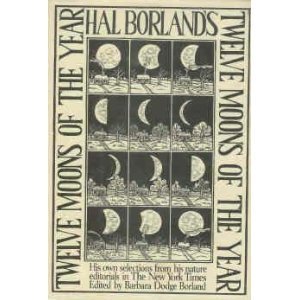
An excerpt from
Hal Borland’s Twelve Moons of the Year
Migrating Monarchs . September 27
Frost has come to rural fields and gardens and the fires of life burn low in the insect world. The bugs and beetles are nearing the end of their time. Crickets and katydids seem to sense it; when you hear them on a warm evening now there is a new sense of urgency in their calls. Bumblebees sleep late, sometimes in the shelter of a tousled zinnia blossom, and wait for the sun to warm their blood enough so they can fly. Most butterflies have had their day and slumber as hostages to tomorrow in the egg, the cocoon, or as caterpillars.
But not all of them. Not the monarchs, those remarkable big black-and-orange butterflies. They migrate, even as the birds. Some of them travel 2,000 miles southward. Their migrant flight is under way now, past its peak in New England.
Like migrant birds, the monarchs follow regular migration routes, down major river valleys, along coastlines, across the high, dry plains. They travel the length of Cape Cod, cross to Long Island, follow its length, then cross to lower Jersey and go on down the coast. THey go down the Pacific Coast in record numbers.
No one is sure why these butterflies migrate, or how they navigate. All we know is that they migrate, by the millions, and that monarchs come back every spring. Some probably are survivors of the host that went south; many—perhaps most—are a new generation hatched on the way north. But they won’t be back until frost-free June.
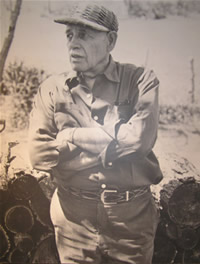
Harold Glen Borland
May 14, 1900 – February 22, 1978
Biography
via essaylet
At the age of five, Borland moved to Colorado with his family in order to live in closer proximity to the natural environment. Borland became aware of the Ute Native Americans as a result of the tribe’s location in Colorado. Borland grew up with an acute familiarity with the outdoors. His experiences in taming broncos have contributed to his depictions of the sport in When the Legends Die. In 1918, Borland attended the University of Colorado for two years before transferring to Columbia University, where he graduated from the School of Journalism in 1923. After serving in the Naval Reserve, he worked in several aspects of the publishing industry, including copy reading, editing, editorial writing, and publicity writing. From 1937–1943, he specialized in nature writing as a staff writer for The New York Times. He also worked as a reporter and a journalist. Borland soon began his literary career with two young adult works of fiction, Valor: The Story of a Dog (1934) and Wapiti Pete: The Story of an Elk (1938). For nearly twenty years, Borland worked as a freelance writer, producing poetry, documentaries, essays, Native American folklore, and two autobiographical works, High, Wide, and Lonesome (1956) and This Hill, This Valley (1957).
Borland began to focus on fiction writing in the 1960s, publishing his first adult novel, The Seventh Winter, in the first year of the decade. Two years later, he published another juvenile novel, The Youngest Shepherd. Borland published his most famous work, When the Legends Die, in 1963. The novel was later adapted to the big screen and translated into nine languages.
Given his background in journalism, Borland also continued to express interest in non-fiction writing, completing Beyond Your Doorstep: A Handbook to the Country in 1962. He also released a collection of his editorials and essays, Sundial of the Seasons, in 1964, followed by a second volume, An American Year, in 1973. Borland died on February 22, 1978, in Sharon, Connecticut, where he had lived on a 300-acre farm with his wife, Barbara Ross Dodge. His farm had been the site of an old Native American village on the Housatonic River many years previous to his residence there.
Borland presents his readers with a remarkably sensitive and insightful portrayal of Native American life in twentieth-century United States. He seems to understand their profound connection to the natural world and their sense of loss at the dissolution of culture and traditions. In When the Legends Die, Borland repeatedly emphasizes the importance of the concept of “roundness,” or the continuity and eternity of old ways, in Ute culture. He recognizes the threat modern American society presents to this continuity.
Borland has made important contributions to the literary world. He is most remembered for his ability to paint vivid pictures of specific geographical areas, through dialect and in-depth visual description. This local color plays prominently in When the Legends Die, which takes place in the southwestern United States.
.






 A LITTLE SOMETHIN'